
Why Are Government Schools Shutting Down in India?
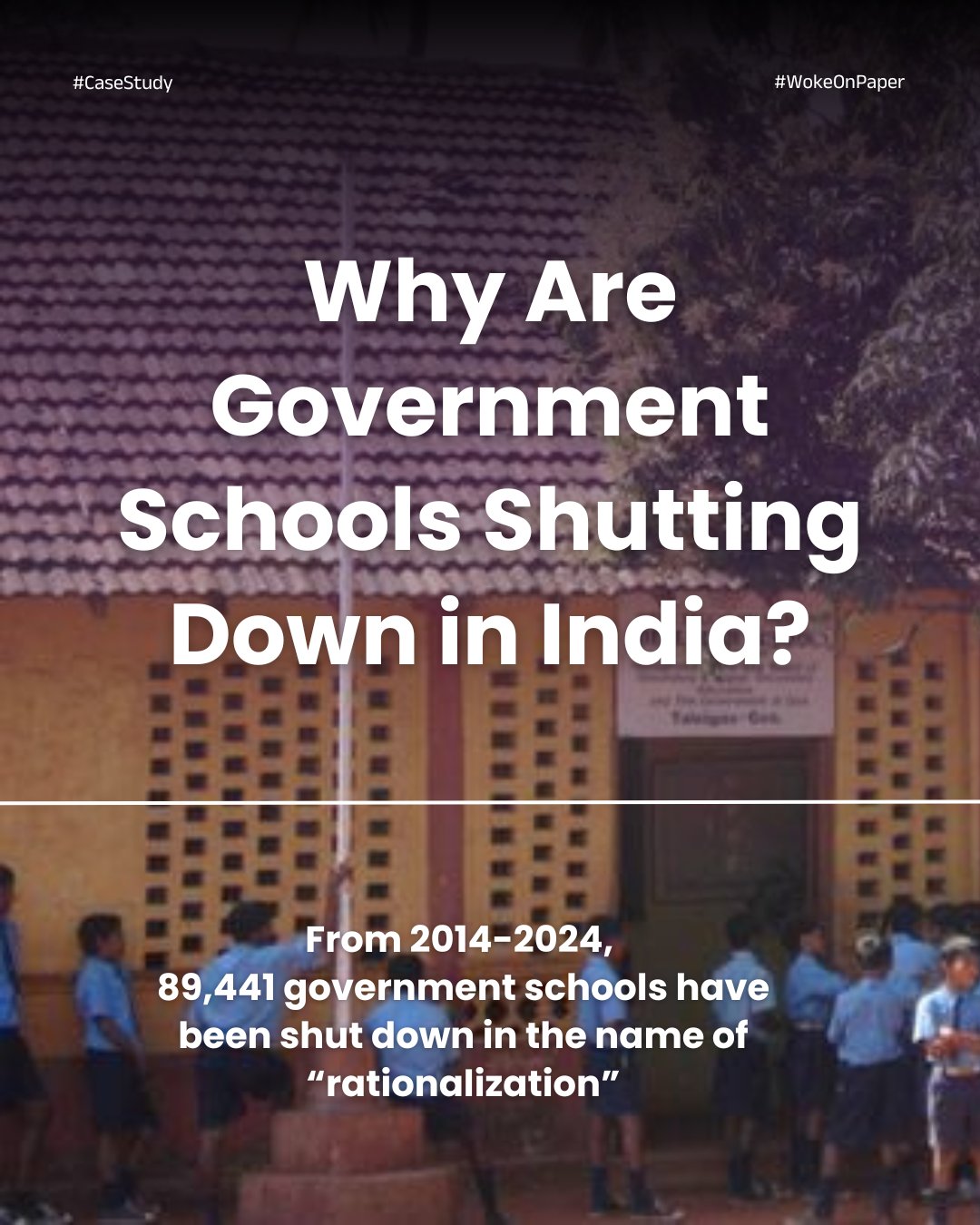
Between 2014 and 2024, 89,441 government schools were shut in the name of "rationalisation". The children they served are paying the price.

89,441 Schools, Gone
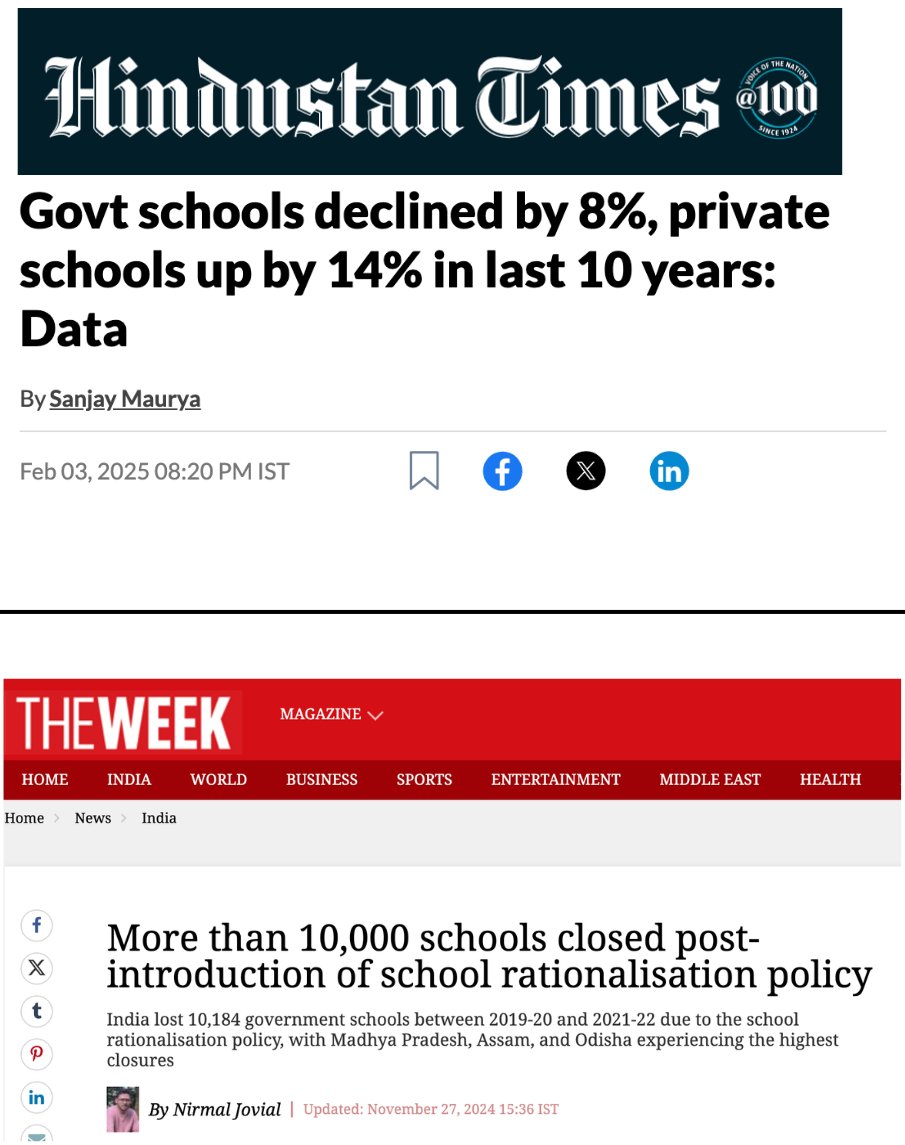
India has seen a steep decline in government schools. Between 2014–15 and 2023–24, 89,441 government schools were shut — a drop of 8%.
Over the same decade, the number of private schools rose by nearly 15%.
| School type | 2014–15 | 2023–24 | Change | % change |
|---|---|---|---|---|
| Government schools | 11,07,101 | 10,17,660 | −89,441 | −8.0% |
| Private schools | 2,88,164 | 3,31,108 | +42,944 | +14.9% |
Source: UDISE+
Where the Schools Closed
The closures are concentrated in a handful of states. Madhya Pradesh and Uttar Pradesh alone lost 54,536 government schools — about 61% of all closures nationwide.
In proportion to their size, the hardest hit were Madhya Pradesh, which lost nearly one in four of its government schools, and Jammu & Kashmir, which lost more than one in five.
| State/UT | 2014–15 | 2023–24 | Schools closed | % decline |
|---|---|---|---|---|
| Madhya Pradesh | 1,21,849 | 92,439 | 29,410 | 24.1% |
| Uttar Pradesh | 1,62,228 | 1,37,102 | 25,126 | 15.5% |
| Odisha | 58,697 | 48,671 | 10,026 | 17.1% |
| Jharkhand | 41,322 | 35,795 | 5,527 | 13.4% |
| Jammu & Kashmir | 23,874 | 18,758 | 5,116 | 21.4% |
| Uttarakhand | 17,753 | 16,201 | 1,552 | 8.7% |
| Arunachal Pradesh | 3,408 | 2,847 | 561 | 16.4% |
| Nagaland | 2,279 | 1,952 | 327 | 14.4% |
| Goa | 906 | 789 | 117 | 12.9% |
Source: UDISE+
Fewer Schools, Fewer Students
The closures have come alongside a fall in the number of children in school. Total enrolment dropped by over 1.22 crore students between 2018–19 and 2023–24.
- Enrolment held steady at around 26 crore from 2012 to 2022.
- The drop of 1.22 crore students (about 6%) between 2018–19 and 2023–24 marks a significant decline.
- 2022–23 and 2023–24 were the first years with major downward shifts after a decade of stability.
| Academic year | Enrolment (crore) | Change from previous | Remarks |
|---|---|---|---|
| 2012–13 | 26.3 | — | Start of UDISE+ data tracking |
| 2018–19 | ~26.0 | Stable | Peak/stable period |
| 2021–22 | ~26.0 | — | Data released in Nov 2022 |
| 2022–23 | 25.18 | ↓ ~0.82 (~3.2%) | Start of notable decline |
| 2023–24 | 24.8 | ↓ 0.38 (~1.5%) | Total drop of 1.22 crore (↓6%) |
Source: UDISE+
What Is School Rationalisation?
So why is the government shutting down its own schools? It calls the policy rationalisation.
Rationalisation means merging or closing small, under-enrolled government schools and reallocating their resources to make education delivery more "efficient".
Closure Is Not a Transfer
On paper, children from a closed school simply move to a nearby one. In practice, it is not that simple.
With the shutting down of schools, parents seek re-admission of their children to another nearby school. It is not an automatic transfer. Students drop out during this process, where parents are not comfortable seeking re-admission because of longer distances.
— Prof. Mehta, former Head of the Department of EMIS, NIEPA/NUEPA, New Delhi
An Economic Logic, Not an Educational One
Rationalisation is rooted in cost-cutting: fewer teachers, fewer buildings, more centralised resources, less government spending.
But what is economically viable is not always socially or morally just.
Education is not just a service; it is a constitutional right. Cutting corners on education for the poor to reduce the fiscal burden sends a damaging signal.
Who Is Hit Hardest
The 2017 MHRD guidelines describe rationalisation as a "participatory and consultative process" meant to improve educational quality and make better use of resources.
In practice, it often means closing schools that serve remote, tribal and socio-economically marginalised communities.
- Most closures happen in remote and tribal areas, affecting Dalit and Adivasi children and those from economically disadvantaged families.
- Girls are especially vulnerable: longer distances and safety concerns often lead to higher dropout rates.
- Rationalisation risks deepening existing inequalities and pushing the most vulnerable children further away from education.
On the Ground in Uttar Pradesh
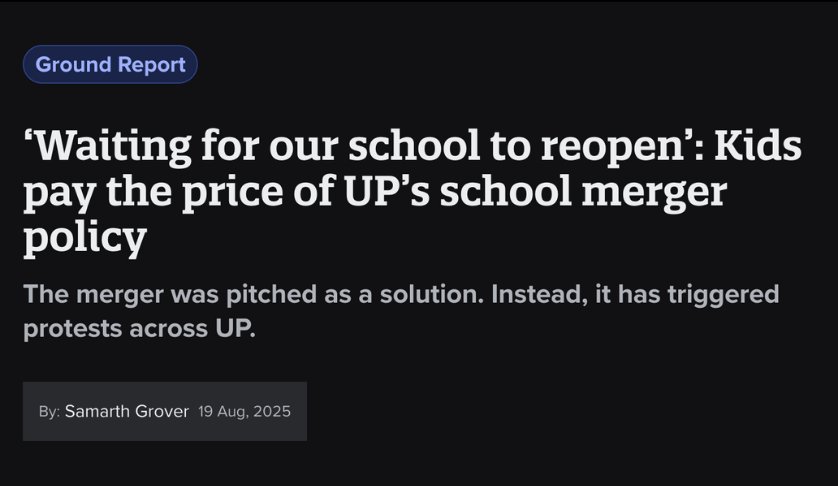
In Uttar Pradesh, where school mergers have triggered protests, parents told Newslaundry that their children "have been sitting at home since July 1".
The road fills up with water. Only if there is no rain there is a road to go… We have just been waiting for the court to reverse this order.
— Avdesh, a parent, speaking to Newslaundry
What Could Be Done Instead
- Strengthen small schools. Equip them with multi-grade teaching support, better infrastructure and digital access.
- Let local context lead. Any closure must be preceded by a deep local needs assessment.
- Centre the community. Let local voices, especially from marginalised groups, lead the decision-making.
- Keep the spirit of the RTE. Ensure access, equity and quality — not just structural compliance.
WokeOnPaper is an independent satire media collective led by a small group of development practitioners. Through memes, stories and commentary, it reflects on the everyday absurdities of the social sector — nudging it towards becoming more honest, participatory and democratic.